Britain’s Hard-Nosed Turn in Foreign Policy: Calculated or Cautious?

Eliza Keogh explores shifting public attitudes, as Britons value pragmatism in foreign policy, backing trade and aid that deliver economic and security returns over values.
In an increasingly competitive and unstable world, the UK faces a growing array of strategic challenges – from great power rivalry and economic fragmentation to regional conflicts and humanitarian crises. As global norms fray and alliances shift, foreign policy is increasingly about navigating hard power dynamics, securing economic resilience, and protecting national interests in a more unpredictable ecosystem. Against this backdrop, understanding how the British public views the UK’s role in the world has never been more critical.
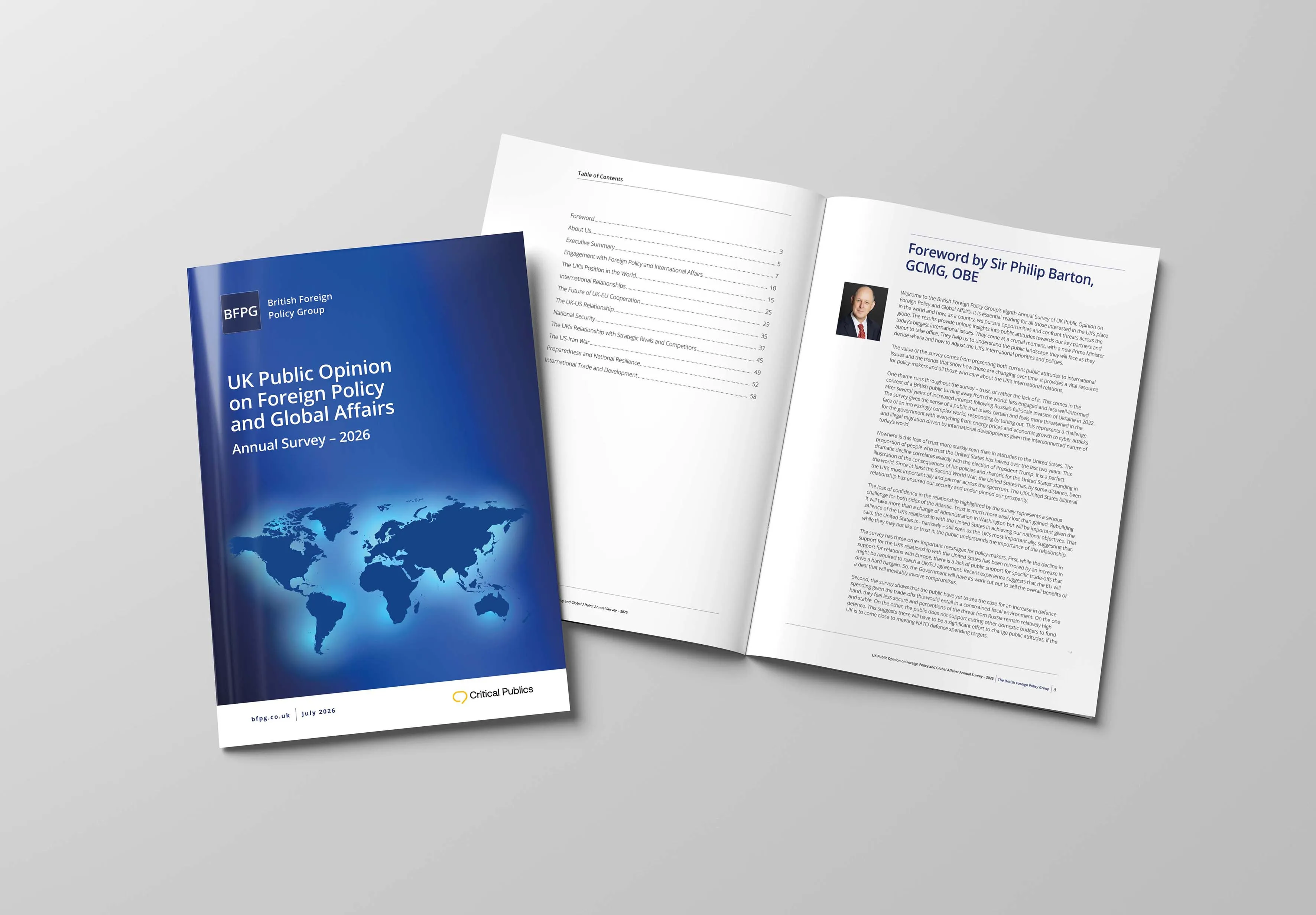
Over the past year, British public attitudes toward foreign policy have undergone a subtle but significant shift. The latest findings from the BFPG’s 2025 Annual Survey on Public Opinion on Foreign Policy suggest a growing pragmatism in how Britons view the UK’s role in the world. Increasingly, the public is favouring a foreign policy rooted in national self-interest, that prizes economic returns and national security over values-based diplomacy.
Principled or Pragmatic Trade
One of the clearest signals of this evolving mindset comes through public attitudes to international trade. While past BFPG surveys highlighted a preference for aligning trade policy with values – for example, favouring partnerships with democracies and countries with strong human rights records – this year’s results show a noticeable pivot.
While Britons are very uncomfortable with President Trump, with the majority of Britons believing he is negatively affecting the UK economy (53%), UK-US relations (49%) and the UK’s national security (41%), 57% still support the UK-US trade deal announced in May 2025. Furthermore, while our 2024 survey revealed Britons’ sharp distrust for India – with more Britons (37%) distrusting than trusting (21%) the country – the majority (53%) of Britons support the July’s UK-India trade deal.
Our focus groups this year have found a similar trend, with Britons from a broad range of demographics making clear that, first and foremost, they want foreign policy to deliver for them economically, even if that means trading with nations with whom they don’t always trust or agree.
Aid for National Interest
This more transactional attitude is also evident in how Britons view the UK’s broader international engagement, including its approach to international development. For decades, the UK public has largely supported development aid based on humanitarian principles, believing that the UK has a moral duty to help those in need. But the 2025 data shows that this sense of moral duty seems to be giving way to a more hard-nosed way of thinking.
Indeed, a plurality (39%) of Britons prioritise promoting UK national interests, albeit this is followed closely by 35% who prioritise addressing immediate humanitarian concerns (e.g. disaster relief). Just 15% of Britons believe the top priority should be supporting other nations’ long-term development.
While not a complete abandonment of humanitarian goals, this marks a significant reordering of public priorities. In BFPG’s 2023 survey, the majority (55%) of Britons said that the UK has a moral duty to use aid and development to contribute to a more secure and prosperous world (55%), while only 44% of Britons were convinced of the security benefits of UK aid and development spending. Looking further back, in 2021, BFPG found the largest proportion of Britons saw moral arguments about duty as the strongest case for aid spending. Instead, Britons are now more focused on the immediate returns of development investments, such as increased security, migration control, and stronger trade deals.
Yet while the public may want aid to deliver more tangible benefits to the UK, there is little appetite to increase the resources needed to achieve these, as just 38% of the public want to spend more than 0.3% of GNI on aid, while a nearly equal 34% want to spend less. This is a marked shift from last year, when just 22% believed the aid budget should be reduced below 0.5% of GNI, as Britons’ willingness to invest in international development wanes against the backdrop of a cost-of-living crisis and global security challenges.
Hard Choices Ahead
What emerges from this year’s survey, therefore, is a public navigating a new foreign policy landscape with a more hard-nosed approach. With difficult domestic decisions to be made and a challenging international environment, the public is increasingly clear – they want a foreign policy that delivers, and delivers quickly and directly, for them. Nonetheless, foreign policy is a complex and unpredictable game which is often as much about avoiding catastrophic costs, not least war, rather than bringing direct gains. For government then, the challenge is how to showcase and generate short-term benefits for the public, while never losing sight of the critical long-term challenges that foreign policy must prioritise.
And it raises crucial questions about the public’s thinking. Do they fully understand the implications of a more transactional and uncompromising foreign policy? And crucially, are they truly prepared for the trade-offs it may demand?
Explore related articles and more.