Disinformation Goes Local: Foreign Interference and the UK’s New Europe Debate
BFPG Associate Fellow James Jennion argues that Russian interference in UK politics is becoming more local and more AI-driven, and the government’s response will have to match.
Prime Minister Andy Burnham is targeting Russian interference in the UK’s democracy with an urgency unseen in his predecessors. It is unsurprising that the ‘TikTok Prime Minister’ recognises the centrality of social media in shaping public sentiment and understands that actors hostile to the UK seek to use it to propagate anger and mistrust. While the problem has long been acknowledged, Burnham has taken two notable recent steps in tackling it, by being the first Prime Minister to publicly acknowledge that Russia interfered in the Brexit referendum debate, and by announcing the National Centre for Information Defence to tackle disinformation.
The acknowledgement that Russia interfered in the Brexit referendum debate – regardless of how effectively – comes as Burnham also seeks to reopen conversations about Britain’s relationship with the European Union. As these conversations develop, Russian state actors and agents will likely intensify efforts to influence them. In 2026 and beyond, they will be able to do so with increasingly AI-facilitated, hyper-localised methods that target individual communities and areas, while simultaneously exploiting national-level divisions and debates.
The aims of Russian interference
Russian interference in democratic processes – in the UK, across Europe, and elsewhere – is driven by a geopolitical logic: to reduce unity among democratic states, which the Russian government claims to be attempting to undermine Russian power and stability. The 2023 Russian Foreign Policy Concept states that the actions of the United States and its ‘satellites’ (including the UK) are “aimed at weakening Russia in every possible way, including at undermining its constructive civilizational role, power, economic and technological capabilities, limiting its sovereignty in foreign and domestic policy, violating its territorial integrity.” This is in many ways a continuation of decades-long disinformation strategy that was first operationalised in Soviet Russia, and constitutes part of Russia’s wider hybrid warfare strategy that includes interference, cyberattacks, sabotage, and other efforts to destabilise its adversaries.
New tools for old strategies: AI, bot farms, and information laundering
While Russia’s information warfare has been ongoing for decades, modern tools have allowed Russia to ramp up both the scale and verisimilitude of its disinformation efforts. The 2016 Brexit referendum took place in a world before generative AI, which has supercharged influence actors’ capabilities to mass-produce misleading information and to tailor that information to audiences to new levels.
Much activity is carried out by state-affiliated actors, rather than formal government institutions. The Social Design Agency (SDA) is a Russian entity funded by the Kremlin and sanctioned by the UK in 2024. The SDA’s tactics include hijacking social media accounts to spread anti-Ukraine messages as part of a wider propaganda strategy that combines official state messaging, paid influencers, bots, and local voices. Storm-1516, a small but active group linked to Russian state bodies, fakes primary sources (interviews, testimonies, etc) and then launders them through mainstream news sources to reach Western audiences.
AI tools are increasingly used to create ‘doppelganger’ websites which imitate credible news sources. In Germany, one disinformation initiative included the creation of fake websites imitating established national publications, such as Der Spiegel, publishing fake stories. Impersonation is used to discredit political candidates that Russian authorities consider unfavourable. Fabricated content on X, for example, claimed incorrectly that French presidential candidate Gabriel Attal had Parkinson’s disease. Following reporting on a high-profile news faking operation, leaked SDA documents confirmed these operations were conducted on behalf of the Russian state to strengthen far-right actors in Europe and undermine support for Ukraine.
These false or ‘spoofed’ sources are increasingly localised, targeting municipal and other sub-national elections. Previous investigations by the BBC identified an operation based in Russia using AI to create hundreds of fake local news stories in the UK, US, France, and other Western countries. For the 2026 Paris mayoral race, Storm-1516 purportedly spoofed the website of a real candidate with claims that the Pompidou Centre would be converted into migrant housing. For the French local elections, analysts identified up to 140 imitation news websites, of which around 20 impersonated local outlets.
During the September 2026 Saxony-Anhalt elections in Germany, Russian actors attempted to exploit regional divides by spreading videos branded with the logos of credible news outlets purporting that East German children were being bullied in West German schools. Additionally, they made attempts to discredit specific local politicians with accusations of embezzlement and sexual offences. As the recent protests have unfolded in Paris, Storm-1516 has been active in sharing false narratives around the events, part of a wider strategy of amplifying and exacerbating existing grievances and divisions within societies.
The use of bots continues to be a fixture of Russia’s interference arsenal, complementing and amplifying AI-generated content. Russian disinformation agents are reportedly using bots to manipulate engagement of social media content in the context of the United States midterm elections, artificially increasing the view counts of AI-generated video clips in which celebrities attack and discredit Democratic Party candidates. These tactics have developed since 2016, when such efforts focused largely on the presidential election. Now, bots are targeting individual state races.
On the day of the 2016 referendum, bot accounts from Russia and other countries sent thousands of messages with reasons to vote Leave. In the context of the UK-EU debate, the most exploitable fault lines are already apparent and largely unchanged from 2016: mainly claims that EU membership could open the floodgates to unchecked migration and would subject the UK to foreign control. It is likely that, as the UK-EU debate continues to develop, Russian efforts will seek to exploit these divisions at national, regional, and local levels to encourage anti-EU sentiment, with a much larger and locally-tailored arsenal to do so.
AI tools can generate locally-focused pages in seconds. With minimal prompting from the author, an AI chatbot generated the following fake news story on UK-EU relations in just over a minute. The below example is intentionally exaggerated, but with extremely basic prompting – including the vague instruction to “use local issues” – the tool identified a contentious local housing development project in a small area of Warrington in North West England, taking local concerns and connecting them to EU-related disinformation:
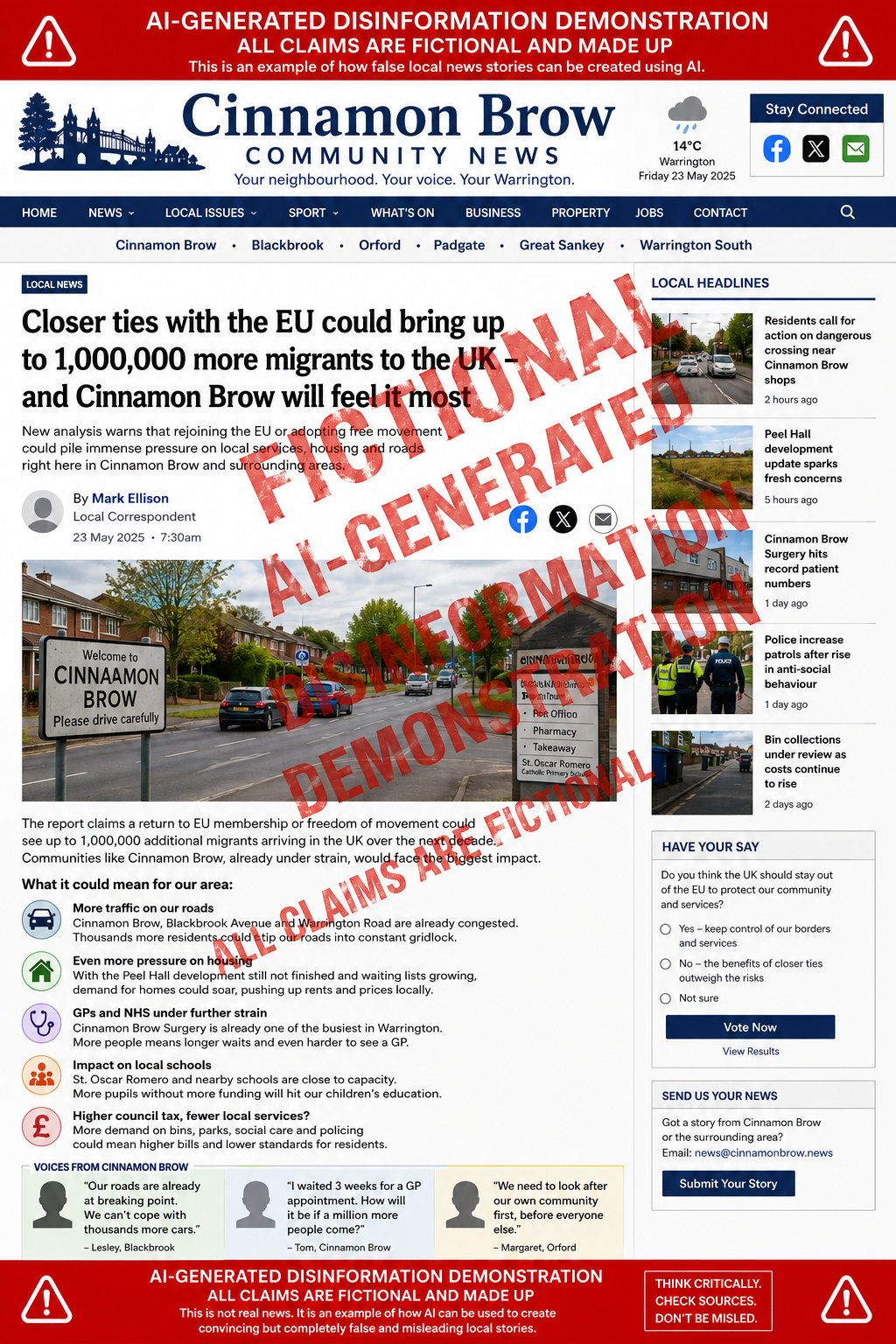
Localisation is particularly germane to the UK-EU question, as a national debate which has traditionally fallen along starkly regional fault lines. The continuing decline of trusted local media will further exacerbate the issue, as the local information vacuum widens and the number of credible reporting platforms continues to dwindle.
Responding to interference
Attacks on UK democracy should be treated as a community-level issue as much as a national security issue. Its impact on major elections aside, disinformation reaches into homes and can drive people out onto the streets to commit violence, harming local businesses, frontline workers, and communities. The new National Centre for Information Defence should develop localised approaches in its work that bring authorities around the UK on board. Being consistently open with the public about foreign adversaries’ interference efforts and bringing these issues into wider conversations and strategies on national resilience will be essential.
Evidence demonstrates that engaging local authorities, police, faith leaders, and community groups in debunking disinformation can be highly effective in limiting its effect and easing tensions within communities. The Centre, for example, could establish focal points within local and regional communities to whom it could flag emerging disinformation narratives and trends and support them with fact checking and verification.
The government has also taken promising steps to strengthen the local information environment through initiatives such as the Local Media Fund, although questions remain as to whether the size of the fund – which has a budget of £12m to disburse in grants over two years – is sufficient. Increasing the size and remit of the fund may be an effective way for Burnham to realise his objectives of strengthening local communities and building the UK’s resilience against foreign interference.
The Prime Minister has acknowledged that certain groups, such as those struggling with the cost of living and those not in education, employment, or training are more likely to be vulnerable to foreign influence, stating that “security starts in every home”. Turning this understanding into results will require the government to develop tailored local strategies to work with councils, community leaders, faith leaders, educational institutions and others to tackle disinformation at every level.
As interference becomes ever more localised, so too should the government’s response.
The views expressed in this article are the author's own and do not necessarily represent those of BFPG.
Explore related articles and more.