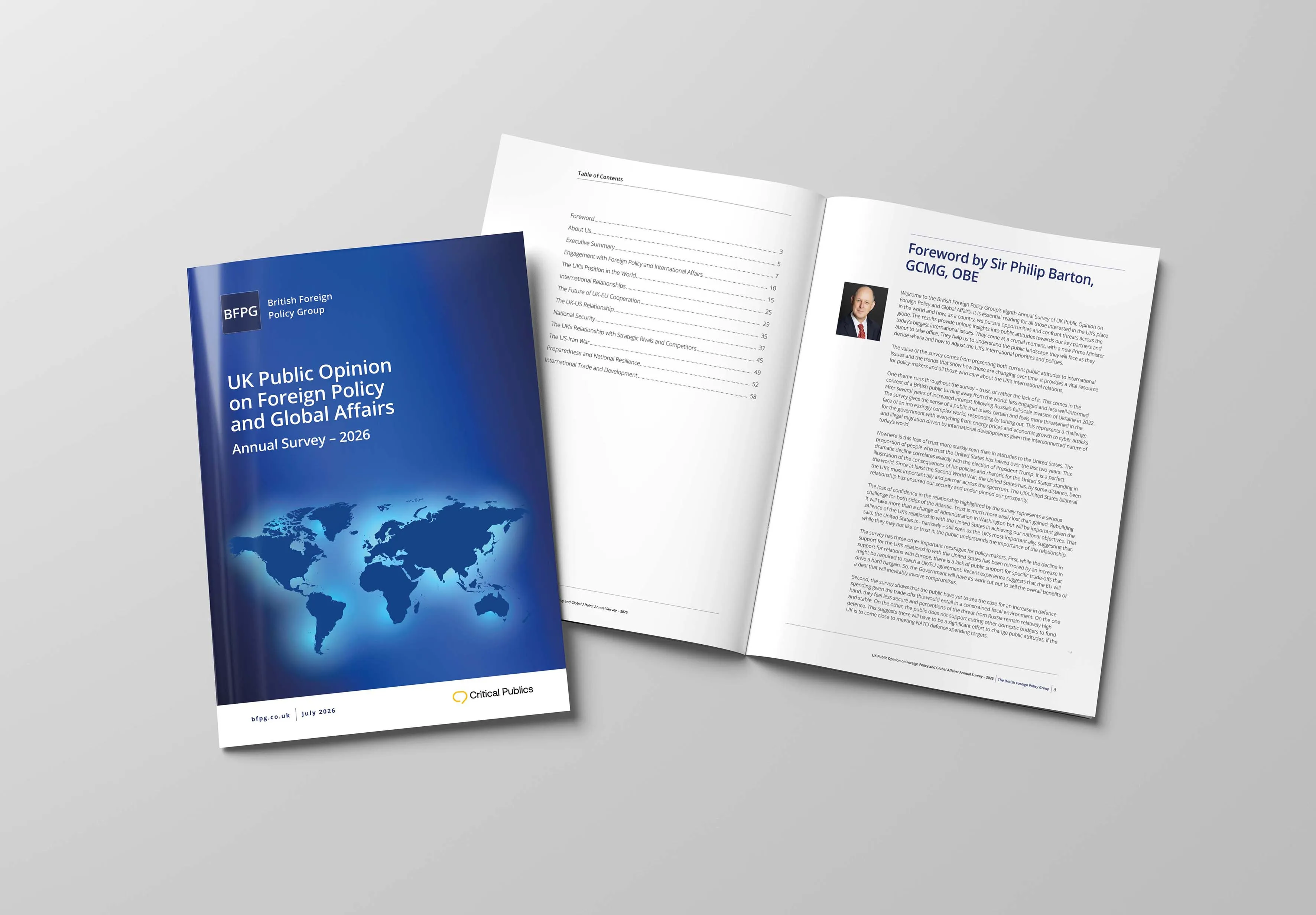
Launch - 2026 Annual Survey of UK Public Opinion on Foreign Policy

We are delighted to release BFPG’s 2026 Annual Survey of UK Public Opinion on Foreign Policy
This is the eighth edition of the survey, which has tracked how Britons view the world and the UK’s place in it since 2019.
This year's findings reveal a British public turning away from the world, as trust in the United States collapses to just 27%, down from 53% just two years ago, driven by widespread concern about President Trump's impact on UK-US relations, the economy, and national security. In response, Britons are pivoting towards Europe and the EU, though this shift is being driven more by flight from the US than by any newfound enthusiasm for Brussels, leaving this support fragile once real trade-offs, from fishing rights to trade barriers, are raised.
Nowhere is this growing distrust and disconnect seen more sharply than among young people, who are rapidly becoming less trusting of the UK's traditional allies, more open to strategic rivals, and less likely to identify as patriots than just a year ago, all while increasingly getting their foreign policy information from TikTok rather than traditional media.
Meanwhile, although Britons agree overwhelmingly that national security should be the UK's top foreign policy priority, support for the defence spending increases needed to deliver it, has fallen and collapses further once the public is asked to accept the trade-offs involved. As the UK navigates a more volatile and contested world, our survey shows that public consent for the difficult decisions ahead cannot be taken for granted.
Key Findings
Trust in the United States collapses: Trust in the United States has fallen from 53% in 2024 to just 27% in 2026, with almost half of Britons (49%) now distrusting the United States to act responsibly on the world stage. Majorities believe President Trump is harming the UK-US relationship (56%) and the UK economy (55%), while a plurality think he is damaging to UK national security (47%).
A pivot to Europe, built on shaky ground: Britons are clear that Europe should be the UK's top priority partnership (49%), well ahead of the United States (20%), with strong backing for cooperation on defence and security (78%), tackling irregular migration (76%) and reducing trade barriers (70%). Yet this enthusiasm rests on discomfort with America rather than any deeper conviction about the EU, and evaporates fast once trade-offs enter the picture. Britons are more likely to oppose than support cutting trade barriers if it means EU boats fishing more in UK waters (37% to 31%).
Superficial support for defence spending: Support for raising defence spending to 3% of GDP, either now or in coming years, has slipped from 71% to 60% over the past year. That falls even further once costs are attached. A majority of Britons (58%) oppose the increase if it comes at the expense of the NHS, while sizeable minorities baulk at cuts to education (46%) or welfare (42%).
Generational divides Are deepening: Young people are becoming less globally-minded, less trusting of traditional allies, and more open to strategic rivals. Just 25% of 18-25-year-olds now identify as patriots, down from 41% a year ago, and this age group now more often distrusts the United States (50%) than China (36%). This shift is unfolding against the backdrop of a fracturing information ecosystem, with TikTok now the most widely used primary source of foreign policy information among 18-25-year-olds (42%), compared to just 1% of over-66s.
A willing but not fully ready public: Britons remain unconvinced the UK is prepared for a major conflict, but there is a clear well of goodwill to contribute in a crisis. 76% of Britons are willing to help distribute food, medical or emergency supplies, and 71% are willing to help keep essential services running. Yet significant gaps remain between willingness and ability, most starkly among over-66s, 72% of whom are willing to help keep essential services running but 41% feel able to do so, pointing to a clear opportunity for the Government to train and mobilise the public more effectively to support national resilience.
Explore related articles and more.