Expert roundtable: The UK’s position in the international AI landscape
On 4 December 2025, the BFPG was delighted to partner with the Centre for the Governance of AI for an expert roundtable on how the UK can best navigate the global AI landscape.
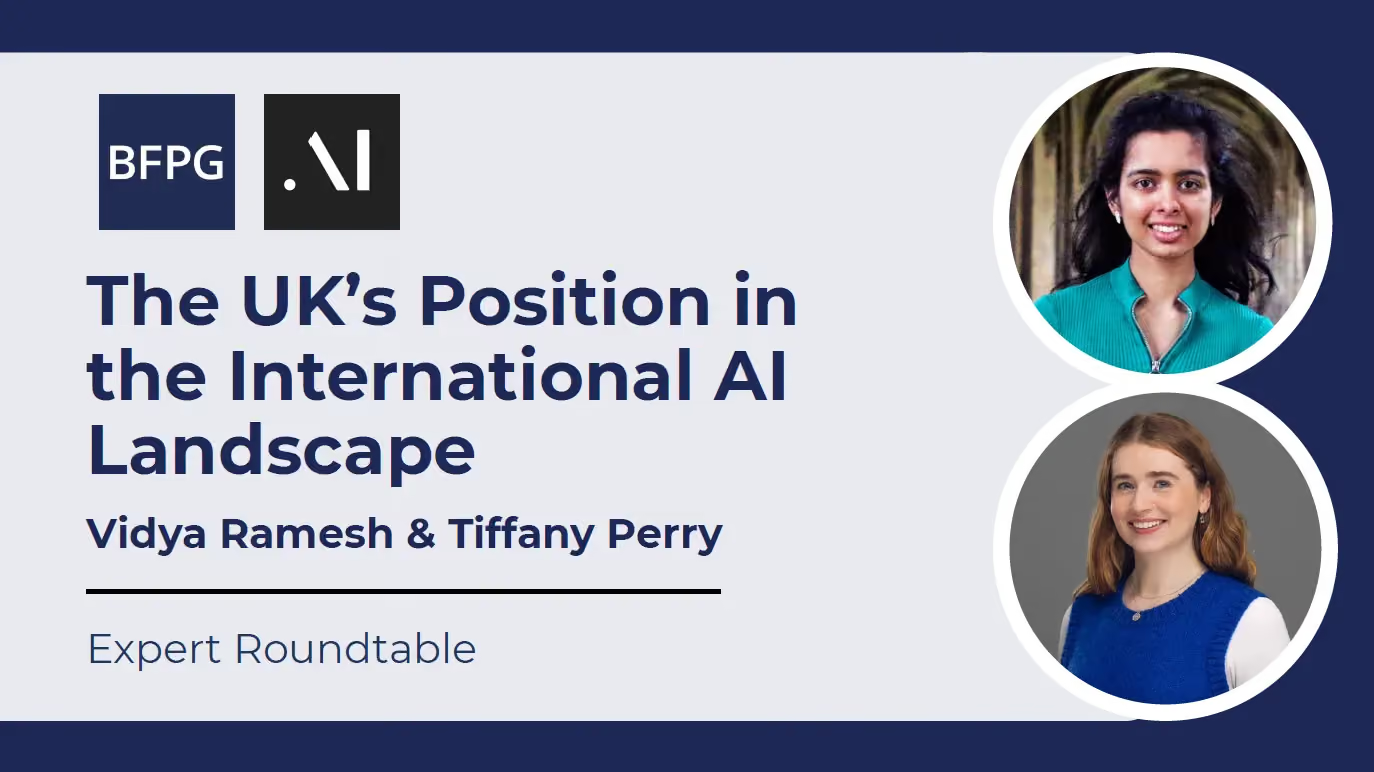

On 4 December 2025, the BFPG was delighted to partner with the Centre for the Governance of AI for an expert roundtable on how the UK can best navigate the global AI landscape.
The United States and China are the indisputable frontrunners in AI development, a dominance that carries profound implications for global standard-setting, economic advantage, and national sovereignty. In this rapidly evolving landscape, the United Kingdom must find a way to maintain economic and technological relevance, and sustain its international influence to uphold its national values and support its strategic objectives.
To explore how the UK can best navigate the global AI landscape, the British Foreign Policy Group was pleased to partner with the Centre for the Governance of AI (GovAI) for an expert roundtable, bringing together the AI research and foreign policy communities including from the Alan Turing Institute, Demos, the Institute for AI Policy and Strategy, and the Oxford China Policy Lab.
The discussion was underpinned by research conducted by two GovAI Seasonal Fellows: Vidya Ramesh and Tiffany Perry. Over the summer, they explored two complementary aspects to the UK’s global positioning on AI.
Vidya’s project focused on how the UK Government could develop a framework that articulated and signalled – both to governments and industry – the kinds of international AI partnerships the UK was looking to develop. Vidya’s research identified that the UK should seek to develop international AI partnerships that go deeper than the transactional acquisition of compute and talent with such partnerships instead being geared to enhancing the UK’s security, defence, and industrial advantage. This involves leveraging the US-UK Tech Prosperity Deal for deeper, two-way integration on national security; negotiating access to shared data, notably the European Health Data Space as part of any future AI deal with the European Union and its Member States, and shifting longstanding 5EYs partnerships with countries like Australia and Canada from AI security-centric focus to ones centred on innovation and commercialisation. Ultimately, her work examined how the UK can leverage its niche AI capabilities and strengths to build strategic AI alliances while mitigating risks such as one-way dependency.
Tiffany’s project focused on global AI governance and security. She explored how the UK could draw on its unique strengths to help defuse a possible AI‑related crisis between the United States and China. Through a combination of literature review and expert interviews, she sought to identify the conditions under which US‑China dialogue might be more or less feasible, and mapped the specific advantages the UK holds in AI governance. Drawing these insights together, she outlined practical ways the UK could support dialogue between the two superpowers and the preparatory steps needed to play this role effectively.
Taken together, Vidya and Tiffany’s work illuminate the twin imperatives facing the UK: both the geopolitical pressures shaped by US-China dynamics and the specific opportunities it must seize to carve out a constructive leadership role in the AI domain.
In the first half of the session, experts considered the UK’s strategic currency in international AI partnership building. A major focus was how diplomats could negotiate deals to prevent an asset ‘drain’ and ensure the retention of Intellectual Property. Discussions also covered the complex trade-offs in values-based diplomacy, such as collaborating with non-traditional allies on critical infrastructure like clean data centres, and the role of post-Brexit trade deals in promoting UK AI services. Particular attention was paid to the rising influence of India, whose scale in data, talent and its growing market – coupled with its ambition for a sovereign foundational model – demands a deep and nuanced partnership with the UK.
In the second half, discussion turned to what the UK could offer the international community on AI governance. Particular attention was paid to China, with experts emphasising the importance of developing a coherent approach to UK‑China engagement and building stronger China expertise within the UK Government. Strengthening this capability was seen as essential not only for managing risks but also for identifying opportunities for constructive dialogue and cooperation.
Overall, the session highlighted the pressing need for the UK to articulate a clear, strategic vision for its role in global AI governance. This vision must accurately reflect the UK’s place in a global AI competition shaped by the US and China, yet leverage its strengths to proactively shape emerging norms and standards in line with its national interests.