A New Civil Partnership: The Case for a National Resilience Corps.
Think Labour's latest report, co-authored by BFPG Senior Fellow Ed Arnold, and Senior Researcher Jack Pannell sets out the case for a voluntary National Resilience Corps, drawing on fresh polling, focus groups and lessons from allied whole-of-society defence models.
Download Report ↗︎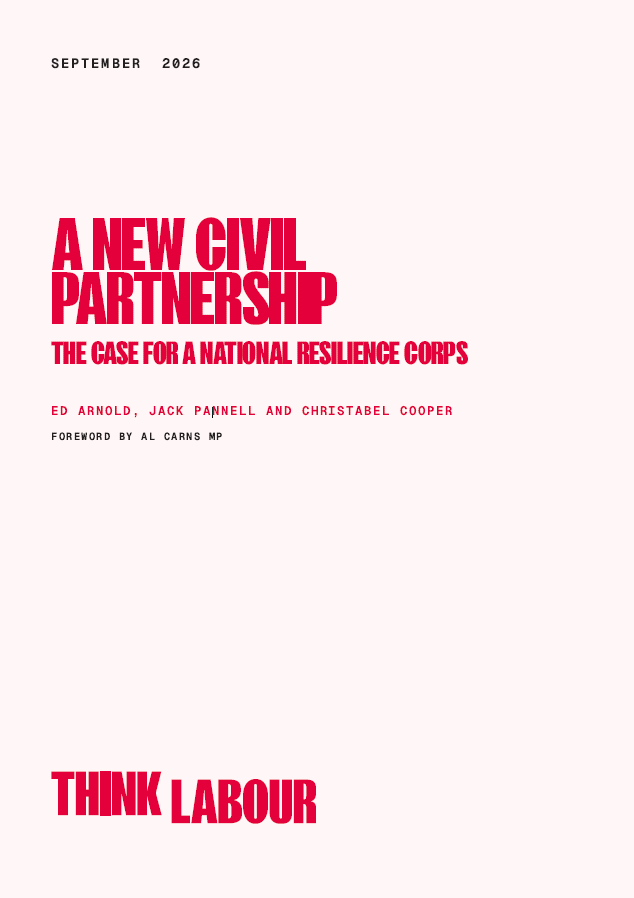
Russia's war in Ukraine continues unabated, China poses growing strategic challenges, cyberattacks against the UK are becoming more frequent, and the United States is a less reliable ally. The UK needs to strengthen both its defence capabilities and its broader national resilience, and that conversation needs to move beyond Westminster.
New polling for this report, produced jointly by BFPG and ThinkLabour, finds:
- The public see a wide range of threats, including a terrorist attack, an attack on the economy and election interference, as fairly likely to happen in the UK within the next five years
- The public overwhelmingly believe responsibility for preparing for these threats sits with the government rather than with communities or individuals
- No political party is currently trusted, on balance, to keep the country safe
- There is little public appetite for funding higher defence spending through higher taxes or cuts to public services
At the same time, up to 76% of the public say they would be willing to help in a crisis, distributing medicine and food, for example, even if many aren't confident they currently have the skills to do so.
In response, the report, authored by BFPG's Ed Arnold and Jack Pannell alongside ThinkLabour's Christabel Cooper, with a foreword by Al Carns MP, proposes a new National Resilience Corps (NRC): a voluntary scheme bringing civilians together to train and prepare for a range of crises. The NRC would be:
- Voluntary and open to all, aged 18 to 70. 47% of those polled backed the idea, against just 12% opposed, with younger voters the most supportive
- Built around existing civilian skills, matched to the UK's 13 Critical National Infrastructure sectors
- Light-touch to join, with 10 days of initial training followed by two half-days a month, so trained volunteers can free up specialists for where they're needed most
- Properly incentivised, with student loan reductions, tax incentives and rail cards for volunteers, and accreditation and National Insurance relief for employers who release staff
Drawing on lessons from Sweden, Norway, Finland and Germany, the report estimates a pilot of 10,000 volunteers would cost around £90 million a year, rising to £240 million by year five as it scales to 50,000.
Defence is a collective endeavour. In a more dangerous world, the UK needs institutions that build a more cohesive society, and the National Resilience Corps is a place to start.