The Place of Aid in an Unstable World
.webp)
Sofia Pennacchietti examines the public's views on international development, and how it can fit into a wider UK foreign policy strategy
Last week Ed Miliband, the new Foreign Secretary and a staunch supporter of both international development and climate action, announced that he would himself betaking the UK seat at the World Bank, a role usually delegated to a junior minister, stating: “international development is not an add-on to British Foreign policy – it is central to it.”
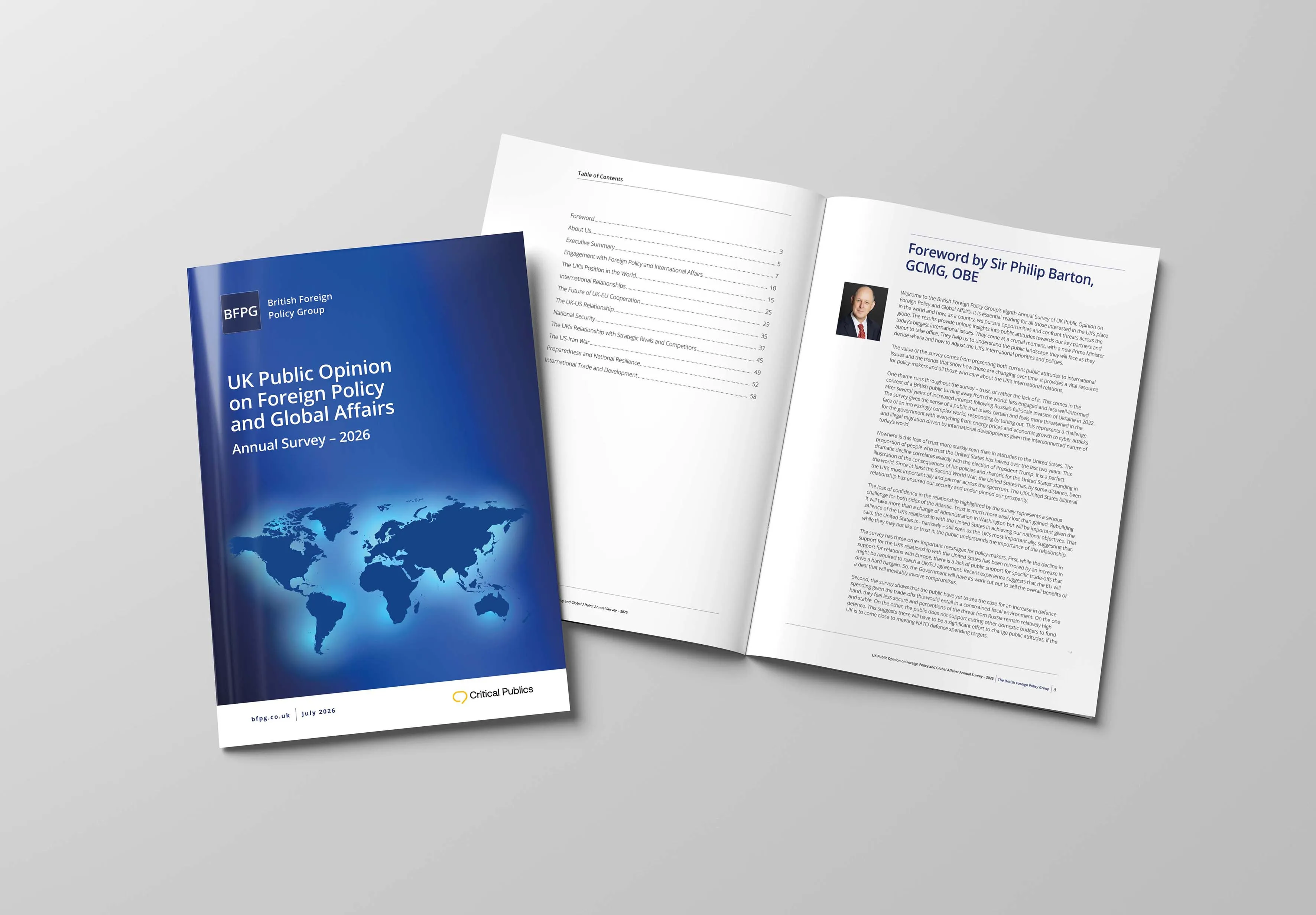
While Ed Miliband’s views on this come as no surprise, it is currently not the position shared by the British public as a whole. BFPG’s 2026 Annual Survey finds that across the board, Britons have begun to turn away from the world. This disengagement extends to attitudes towards international development. Britons are increasingly sceptical of its role and unconvinced of its importance or usefulness as a mechanism in UK foreign policy.
If the government sees international development as an integral part of UK foreign policy, our research suggests that it will need to frame development assistance as a foreign policy mechanism that enhances UK resilience and national security and ultimately benefits Britons at home.
Spending on International Development has contracted in recent years, and Britons are unpersuaded as to its importance
The UK is operating with a much smaller international development budget than in recent years, and there’s plenty of evidence that it has fallen significantly down the order of priorities. Last week, we saw that PM Andy Burnham’s announcement on new caps on bus fares was made possible by readjusting climate finance aid from grants to repayable loans. Thus far, Burnham’s focus seems to align with a British public that cares much more about domestic issues – specifically the cost of living – and so these sorts of political trade-offs will become increasingly prevalent if the government wants to deliver domestically.
Our linear analysis suggests that Britons have become more transactional in their views towards foreign policy and less supportive of international development. Only 19% support the UK returning to 0.7% of GNI for international development originally set as a target in the 1970s and enshrined in law in 2015. That said, 36% of Britons believe the UK should spend more than the 0.3% announced by Keir Starmer in 2025, while 30% believe it should spend less than 0.3%. Both numbers have fallen since last year, by 2% and 4% respectively.
This is perhaps understandable: our wider research suggests that the complexity of the world has made Britons less certain about how they believe the UK should approach key issues and relationships.
International development offers an opportunity to win over increasingly disengaged younger voters
While there is no doubt that overall international development is currently not a vote-winner in the UK, these trends do not hold across all demographics. Young voters are most in favour of development spending: the majority of 18-25-year-olds (51%) think the UK should spend more than 0.3% of GNI on international development, as do a plurality(47%) of 26-35-year-olds.
This may give the government cause for hope. Yet, at the same time, there is a gap between government and young voters when it comes to communication on foreign policy issues. BFPG’s survey includes a range of findings on how younger people see the UK’s place in the world and our international relationships. They appear far more trusting of the UK’s strategic rivals, even trusting China more than the United States. Their views increasingly diverge both from older generations and the country’s established foreign policy priorities. If there is a clear UK approach to the world – whether that is marked by a “values-based” foreign policy, a 2000s liberal interventionism, a modern-day progressive realism, or something else – young people have not bought into it.
As Britons grow increasingly transactional in their approach to foreign affairs, the government will need to talk to young voters on their own terms and ensure that foreign policy offers them something. Maybe international development is part of the answer? If, as Ed Miliband has said, it is “central” to foreign policy, then it potentially offers a route to bringing younger voters more into the conversation on the UK’s role in the world.
If the government wishes to fully utilise international development, it needs to show benefits to the public
As with so many of the key questions for British foreign policy, government needs to be clear with the public about why it should care about an issue if it wants to dedicate time, and more importantly money, to the cause. Young voters may be on board, but selling international development as a positive vehicle for UK foreign policy requires a clearer articulation beyond the “values-based” foreign policy which our research suggests no longer works as strongly as it once did.
47% of Britons believe national security should be one of the UK’s top foreign policy priorities, nine points ahead of any other option; it’s also featured in the top three priorities of every age group and 2024 voter group. Older generations view Russia and China as far greater threats than younger generations. China, for example, has expanded its diplomatic and economic influence around the world, financing competitive assistance projects in regions including Sub-Saharan Africa and Latin America. Historically, USAID and other Western programmes provided an alternative aid offer to those regions, but the depletion of Western aid budgets leaves the UK’s strategic rivals to fill the vacuum. Communicating international development as a means of enhancing national security through strengthening institutions around the world as well as the UK’s bilateral relations, and countering Russian and Chinese ‘anti-Western’ activity, may be a compelling message to older generations too.
As far as threats are concerned, irregular migration ranked second at 35%, just one percentage point below Russian aggression in Europe. For all age groups over26, irregular migration was among the top three challenges to UK security. Development aid has historically been used to address the ‘root causes’ of migration to reduce flows; however, it remains difficult to draw a direct line between development initiatives and migration flows. What is known is that aid can temporarily reduce irregular migration, but it may not lead to increased regular migration as conditions improve over time. Development aid plays an important role in the day-to-day life of communities in recipient countries –supporting livelihoods, health, education and climate adaptation. As aid shrinks, more people may need or want to move, but fewer have the resources to do so, leaving populations trapped in precarious conditions, whether at home or along migration routes. There can then be the makings of a compelling narrative that aid can serve as a lever to limit irregular migration and promote safe, regular migration patterns.
Overall, a UK foreign policy that truly sees international development as central to its success must take the public along with it. With less fiscal space, it will be paramount for the government to clearly communicate – to a public that is increasingly disengaged from global affairs – how it plans to balance its foreign and domestic priorities. It will be critical to express why foreign policy is integral to the domestic realm and how international development contributes to this. The emphasis should be on how, amid geopolitically turbulent circumstances, international development contributes to national security – whether through soft power, ‘values-based’ foreign policy, international influence or by helping reduce irregular migration – and thereby ultimately delivers on the country’s priorities.
Explore related articles and more.