The P5 and NPT Review Process: Guest Series
This series brings together four guest papers by academics and experts on nuclear non-proliferation, arms control and risk reduction, written for the British Foreign Policy Group.
Download Report ↗︎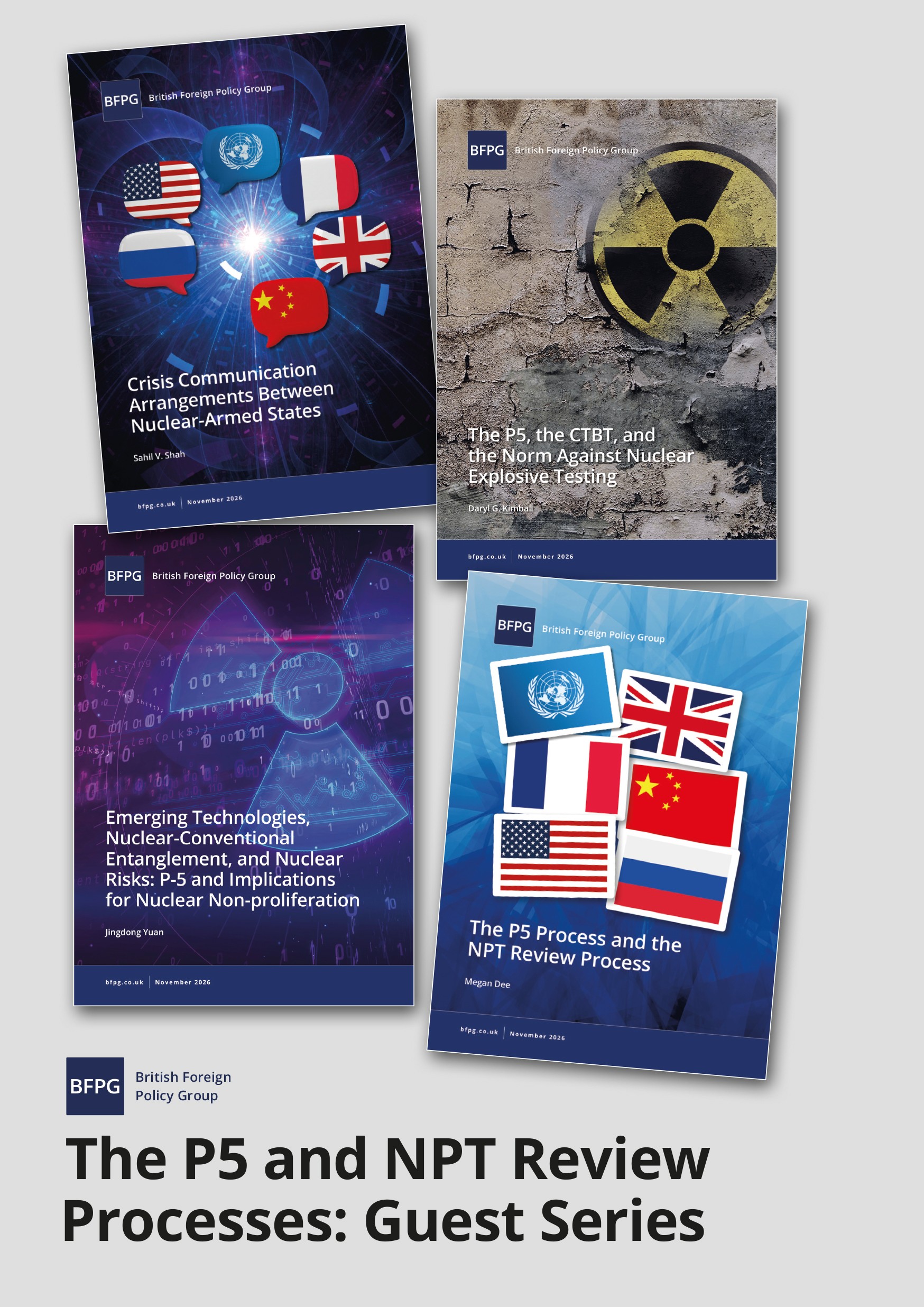
A foreword from our Executive Chair:
This series of papers includes contributions written by academics and experts on the P5 and NPT Review Processes for the British Foreign Policy Group. While detailed research on nuclear non-proliferation is beyond the scope of BFPG’s regular activities, sustaining the NPT and the broader non-proliferation regime has long been an important priority for the UK and is an essential part of what it means to be a Nuclear Weapons State under the Treaty.
Precisely because this touches on the most sensitive aspects of defence and arms control, “track 2” and other discussions play an important role in surfacing ideas and promoting dialogue beyond the closely-held world of government experts. This is all the more valuable at a time of heightened political tensions affecting both the P5 and the rest of the world, which is perhaps reflected in the largely inconclusive outcome of this year’s NPT RevCon.
These papers examine how the now well-established elements of the non-proliferation regime come up against contemporary political and technological challenges and provide ideas for discussion which we may hope will be taken up, particularly among the P5. Having worked in this space in the UK Government in which I saw at first hand the valuable contribution of the wider expert community, I am particularly pleased that we have been able to support this research and ensure that their work receives a wider readership.
David Landsman, Execuitve Chair, Britsh Foreign Policy Group
The P5 Process and the NPT Review Process
Megan Dee examines how the P5 Process can stay relevant to the NPT review process at a time of deep division among the nuclear-weapon states.
The P5, the CTBT, and the Norm Against Nuclear Explosive Testing
Daryl G. Kimball argues that the P5 need to act now to protect the global moratorium on nuclear explosive testing.
Crisis Communication Arrangements Between Nuclear-Armed States
Sahil V. Shah argues that the P5 must turn their shared support for crisis communication into channels that work reliably under pressure.
Emerging Technologies, Nuclear-Conventional Entanglement, and Nuclear Risks
Jingdong Yuan examines how artificial intelligence and the blurring of conventional and nuclear systems are raising the risk of nuclear escalation.